
One of my favorite topics to give khutbahs about is the chapters at the very end of the Qur’an: brief—many only a few lines in length—yet holding oceans of meaning. It is no coincidence that most of these chapters were revealed in the Meccan period of the Sirah, wherein the focus of the Prophetic mission was on forming the Islamic identity, building a collective that transcended racial and tribal norms, and confronting societal ills—both their spiritual and material.
By virtue of being revealed in a period where many of the jurisprudential rulings that we have come to identify Islam with were not yet present, reflecting on these shorter Meccan chapters offers us insight into the essence of Islam: when Muslims were not yet identified through their prayer and fasting, what were their defining characteristics? What was the Message that led Sumayyah (RA) to hold firm to the Message till her martyrdom, far before the bulk of Islam’s rituals were legislated?
One such chapter is Surat al-Maʿun: The Chapter of the Most Meager of Help. This chapter is worthy of even further reflection due to its unique revelational context: despite its short length, many scholars hold that the chapter was revealed in two parts, with the first (verses 1-3) being Meccan in origin and the latter (verses 4-7) Medinan.
The chapter begins with a striking question: have you seen the one who denies the Judgment? In the Meccan environment of rampant paganism and violent Islamophobia, one would anticipate the answer to be a reference to any one of the crimes of Quraysh at the time: the one who denies the Judgment is the one who tortures the believers, the one who bows and slaughters to idols, the one who desecrates the Sacred Mosque. Yet, the Divine answer shifts one’s attention from these grand and outrageous acts of disbelief to ones that we find rampant within our own communities today: the one who denies the Judgment is the one who repulses the orphan and does not urge others to feed the needy.
The Quranic line of questioning forces us to confront our existing notions of belief: if the Divine response to the question had been that the one who denies the Judgment is merely the one who does not pray or does not testify to the oneness of God, we would have found ourselves feeling a false sense of security. Why should I be worried if I do not fall into this category? I pray, I fast, I bear witness to the testimony of faith—this chapter must not be relevant to me. As such, the answer being tied to one’s treatment of the most vulnerable in society shifts our thinking from a legalistic one to one of a far more holistic framework. As Sayyid Qutb (RH) notes in his commentary on this chapter:
We do not intend here to indulge in a juristic discussion on the boundaries of faith and Islam. These are required in legal affairs, whereas this surah states the facts from God’s point of view and judgement, which is quite different from the legal aspect.
The ummah today—largely as a result of colonial endeavors to codify and standardize Islamic jurisprudence, a process which was inherently flawed due to the assumption that shari’a was akin to Western codes of law—has hyperfixated on the legal dimensions of this din to the detriment of its spiritual and ethical dimensions.
Perhaps no incident illustrates the tragic fruit of such an approach than that of Ibn ‘Umar (RA) and the Iraqi pilgrim. Shortly after the Massacre of Karbala—wherein the grandson of the Prophet (S), Imam Hussein (RA), and dozens of his family members were slaughtered by claimants to the Islamic faith—an Iraqi pilgrim approached Ibn ‘Umar (RA) during Hajj with a pressing question: does the blood of a mosquito invalidate one’s ihram? Ibn ‘Umar inquired as to the pilgrim’s hometown and, upon hearing that he was from Iraq—the very place where Imam Hussein was martyred—responded in outrage: “Look at that! He is asking me about the blood of mosquitoes while they (i.e., his people) have killed the grandson of the Prophet!”
Ibn ‘Umar’s point was not that the pilgrim’s question was not a valid jurisprudential inquiry—nor that an answer to it did not exist—but that our tradition is one of priorities. The most pressing concern of those who failed to prevent the massacre of Karbala should not be whether they accidentally invalidated their ihram by swatting at a mosquito, but rather whether their pilgrimage will be accepted in the first place; their questions should have been regarding repentance and societal upheaval: what can we do to prevent such a calamity from occurring again? How do we ensure that Karbala is not repeated centuries later in Gaza and Sudan? In the words of Sh. Mahmous Sha’ban (may God hasten his release):
Whoever sees the blood of the Muslims spilled and is silent—or speaks of prayer and charity—while allowing the blood of God’s creation to continue to be spilled is a traitor!
Returning to the Chapter, denial of the faith is manifested through one’s arrogance and ill-treatment of the orphans and impoverished. Such a person repulses the orphan and does not urge others to feed the needy, let alone feed them themselves. As such, one measure of our faith is through its dunywai manifestations: what have our endless degrees, ijazahs, and fidelity to the letter of the law produced? If my supposed religiosity and Islamic knowledge has allowed my existing spiritual maladies—arrogance, stinginess, heedlessness—to take on a religious garb, my faux piety is objectively worse for my hereafter than if I was merely ignorant—at least then, I would have some sort of excuse for my behavior.
It is baffling to witness those who proclaim to have become more religious become burdens on our community—those whose “religiosity” deactivates them and transforms them into caricatures of Islamic practice, obsessed with the blood of mosquitos, the length of one’s thobe, and fullness of one’s beard. How far removed they are from Muhammadan Islam—one established on “Establish peace, feed the people, uphold the ties of kinship, and pray at night while people are asleep.”
They seek an “American Islam”—one that is referenced for the nullifiers of ablution but is not referenced in discussions of the Muslims’ political, economic, social, and financial affairs. It is a mockery! Rather, it is a catastrophe!
The Chapter then shifts to the Hypocrites with a verse that jolts the reader into attention: So woe to those who pray!—but are heedless of their prayer; those who show off…
As a side note, the reason many scholars held that this section is Medinan is that the phenomenon of the Hypocrites—those who outwardly expressed Islam but were, inwardly, disbelievers—was not found prior to the migration to Medina. Indeed, why would anyone pretend to be Muslim in Mecca? The only reward one would have for such a performance would be to be prosecuted alongside the rest of the believers. However, in Medina, those infatuated with love of worldly gain suddenly found Islam to be in vogue: Muslims now had political, military, and social power; they fought battles and acquired spoils of war; they established markets and oversaw trade routes. Now, there was much to be gained by pretending to be Muslim. In a way, the continued existence of hypocrites in the ummah today is somewhat comforting: people still find reasons to pretend to be Muslim. If a disbeliever in this faith finds dunywai reasons to feign Islam, what is to be said of true believers who have all the more dunywai and akhiri reasons to carry this faith with pride?
The first characteristic God uses to describe the Hypocrites is that they are people of prayer. Indeed, such people not only prayed in the mosque of the Prophet (S), they even went a step further by establishing their own rival mosque—Masjid al-Dirar. Yet, their prayer lacks any inner dimension: it is done in heedlessness and with the sole purpose of showing others their supposed piety.
How common is it today that we witness this faith become a mere ornament? How many a country builds the most magnificent of mosques and hosts the most beautiful of Quran recitation contests in them, only to sign normalization agreements in those same sacred grounds? How many a scholar has used the Quran to justify massacres of their own people, selling the Words of the Divine to the highest bidder? One famous saying describes how, in Nasser-era Egypt, the government would “honor one person for reciting the Quran and, on the same day, execute another for applying it!”
Piety, then, is not in turning your face towards East or West in prayer but in believing and then following belief with personal and societal transformation: piety is found in those who give away some of their wealth, however much they cherish it, to their relatives, to orphans, the needy, travellers and beggars, and to liberate those in bondage; those who keep up the prayer and pay the prescribed alms; who keep pledges whenever they make them; who are steadfast in misfortune, adversity, and times of danger.
The Chapter concludes with the final description of the Hypocrites: they are those who refuse to give the most meager help. Exegetes note that the term used, and the namesake for the Chapter—maʿun—refers to things people give to each other, such as salt, water, and other common items. The hallmark of a Hypocrite is not that they will not refuse to give you grandiose assistance, but rather that even the most meager help—one that will in no way harm them or detract from their wealth—is one that they find heavy. As one of the men of Gaza declared to the leaders of neighboring Arab and Muslim lands:
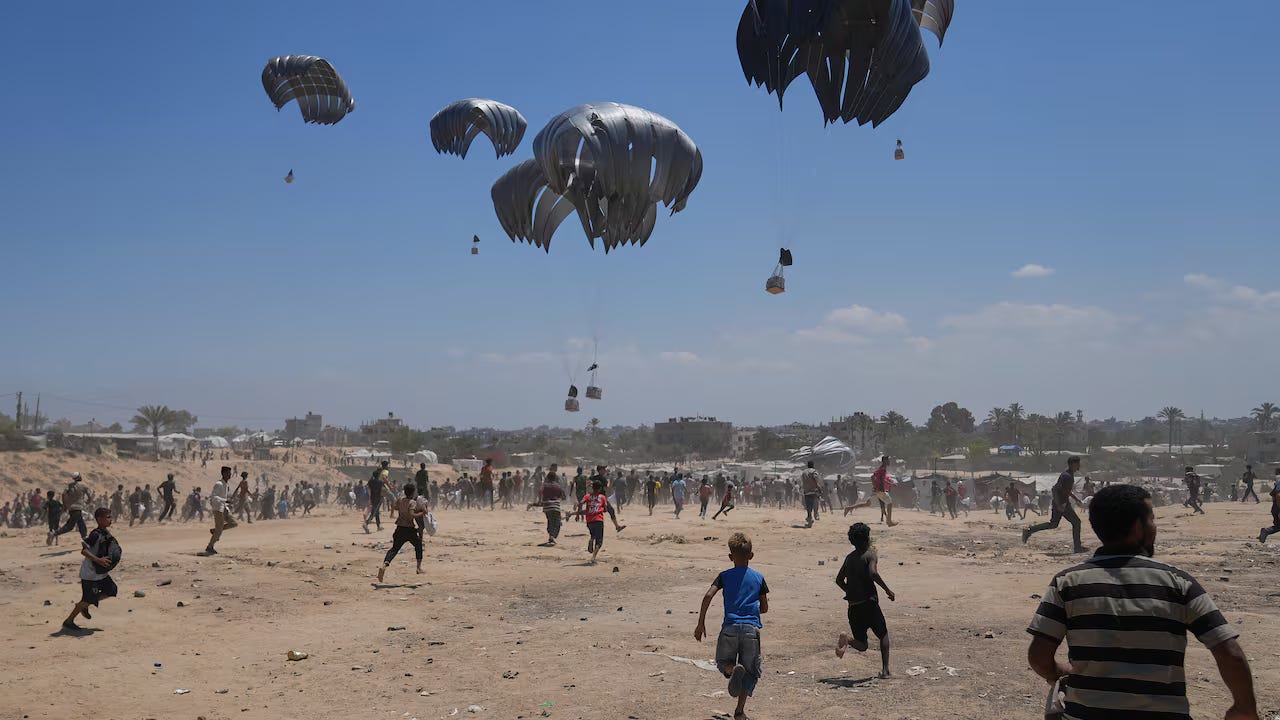
We are not asking you to move to defend the Arab and Muslim children in Gaza by moving your army and your tanks, God forbid. Not to defend the holiest of what you hold holy. We are not asking for that. As we take upon ourselves to sweep this occupation, have your inability and weakness reached the point that you are unable to move relief trucks and humanitarian aid?
God forbid that we expect from you that you would mobilize your armies for the ummah’s cause or for the First Qibla; we already know you to be far removed from such a task. But has your cowardice reached a point where you are unable to muster up a water bottle, a nylon tent, and a funeral shroud—to cover the bodies of your dead brothers and sisters, as well as your own shame?
An ummah without ma’un is no ummah at all. Societal transformation begins with a localized culture of service, love, and accountability. We cannot dream of following the model of Medina when we have failed to establish the spiritual and ethical foundations of such a community that began in Mecca.
“A Muslim is the brother of a Muslim: he does not wrong him, forsake him, or look down upon him.” (Sahih Muslim 2564)